Part Two: BTS and BTS ARMY
(This is part two of a two-part case study examining female-dominated fanbases as public relations strategies)
With the introduction and popularization of social media, fans are no longer separated from community; they can easily find online spaces to connect with fellow fans, to bond over inside jokes with, and to organize projects from all over the world without leaving their bed.
If The Beatles were the first modern iterations of the “boy band,” then BTS would be their social successor in fandom culture and history in its influence and global reach, using social media as a communication channel.
BTS broke out of its popularity concentrated in South Korea and became the global phenomenon they’re known for with the help of their female-dominant fanbase, ARMY.
As a fan of both groups, the parallels are clear, but what has changed?
What Changed in Female-led Fandoms Since the 1960s to Now?
In the 1960s, fan-artist communication occurred through newsletters, official fan clubs and television appearances. Public relations professionals worked within the workday, and crises were attended to as the day began. It was harder to communicate with anyone at such a massive scale without the assistance of television or newspapers.
Sixty years later, in the 2010s and 2020s, communication is expected 24/7, 7 days a week, all over the world. It’s also expected as soon as possible. While social media can connect fans to each other, it also collapses the distance artists have with their fans. As social media timelines refresh, crises of any kind can emerge every second and require action from PR teams.
The Rise of BTS in South Korea and Beyond
HYBE (previously BigHit Entertainment) is the company that has operated and managed BTS since their conception in 2010 and their official debut in 2013.
They helped create BTS as a small company through a fandom-first strategy. They wanted to cultivate loyal fans, fast. They:
- Created a group (then) Twitter account and had the members communicate with potential fans directly
- Release music “pre-debut” and have potential fans see what the band has to offer
- Post v-logs discussing the process of debuting to potential fans
Their first Korean music show win in 2015 established that they were blowing up, but when they released “DNA” in 2017, and were consequently invited to the American Music Awards, BTS became a global force in entertainment.
How did they get invited to the AMAs in the first place?
With a little help from their international fans, of course.
Let’s explore four ways that ARMY helped BTS achieve the global superstar status they have today.
Four Ways Female ARMY Influence Band Promotions in Modern Day
Comeback Hype
A “comeback” is a phrase only popular in the K-pop fandom space, referring to an artist’s or group’s new/upcoming album rollout period.
A comeback would include:
- Photoshoots
- Teasers for music videos
- Presales for the album
- Livestreams by individual members
- Interviews, particularly with Western media groups in BTS’ case
Once a comeback is announced, fandom spaces work in alongside with the artist’ public relations team to promote their favorite artist’s new music and encourage new fans to pique their interest with the fandom.
It’s important to note that the fandom’s promotion strategy is completely separate from the official company promotional strategy. The fans do this of their own accord.
Unlike how anticipation was built in the 1960s, fandoms now work at all times using social media algorithms to promote artist visibility. Fandoms amplify their favorite artists’ album promotions to show their support for the new music.
Entertainment PR professionals should lean into the support of their fandoms when considering promotional strategies for their own artists.
Fan Projects
What is a fan project?
A fan project is where fans come together, usually on X, and coordinate goodwill initiatives for (typically) nonprofit organizations on behalf of the artist.
They organize these projects through engagement on X to cultivate support and create a positive global impact.
Fan projects may include:
- Charitable donations in the artist’s name
- Billboard advertisements
- Birthday campaigns
Check out the ARMY fan project organization One in an ARMY; recently, for BTS member Jung Kook’s birthday, the organization donated to support families facing food insecurity on Jung Kook’s behalf.
Fan projects demonstrate how fandom can be used to show the purchasing power their audiences have, the global effort and potential collective action they are willing to take, and generate positive press for the group, all without company intervention.
This is all without the direct call to action from the artist, but it overall helps positively support their brand.
While fan projects are currently only popular within K-Pop spaces, entertainment PR professionals should take inspiration from them for possible Corporate Social Responsibility (CSR) initiatives within their own organizations.
Awards and Contest Promotion
Awards ceremony voting in the K-Pop space in the era of social media is compulsory.
Take a look at this post from 2022 promoting BTS’ awards standing with the South Korean Melon Music Awards, which is fan-voted. Dedicated fans, usually young women, create X accounts to help fans show their support for BTS using step-by-step intructions on what to vote, reminders on what awards to vote for, and encouragement to show their favorite artist their dedication and support.
Modern fans of an artist, especially with the addition of social media, make supporting an artist a full-time job. Accounts are constantly made to unite a group of fans to show their support in any way they can.
Let’s go back to the scene of BTS at the 2017 AMAs. Fans advocated for BTS to be recognized by Western awards ceremonies as the group was gaining traction online. They act as a pseudo-publicist and openly promote their success to bigger stages.
Streaming Parties and Music Charting
Streaming parties are widespread online-organized listening sessions where fans of an artist come together to coordinate listening to new or past releases simultaneously to boost music chart performance.
Fans do this to show their love and support for the artist’s music and hopefully boost visibility to mainstream charts like Billboard.
Fans create detailed guides to explain each platform’s rules to avoid view deletion or platform filtering.
Check out these fan-created instructions on how to stream BTS’s music releases to promote them and why fans need to stream their music.
Parasociality in Modern-Day Fandoms
Companies have already tapped into the value of parasocial artist-fan relationships online.
Through platform livestreams, behind-the-scenes content, and personal posts from the members directly, artists employ intimacy to strenghten fan connnection to the artist.
Fans feel seen when they feel that their favorite artist could personally witness their support. Even if it isn’t techincally the entire truth.
However, feeling close to the artist easily translates into metrics, whether it is album sales, engagement numbers or tour ticket sales.
This is a post I made to BTS’s V for his birthday when I was 13 on X. It meant a lot to me knowing that somehow I could personally show my support for him on a platform he could see, and it’s clear to see how this post contributed to the artist’s success. The hashtags I used boosted online engagement for his name on social media.
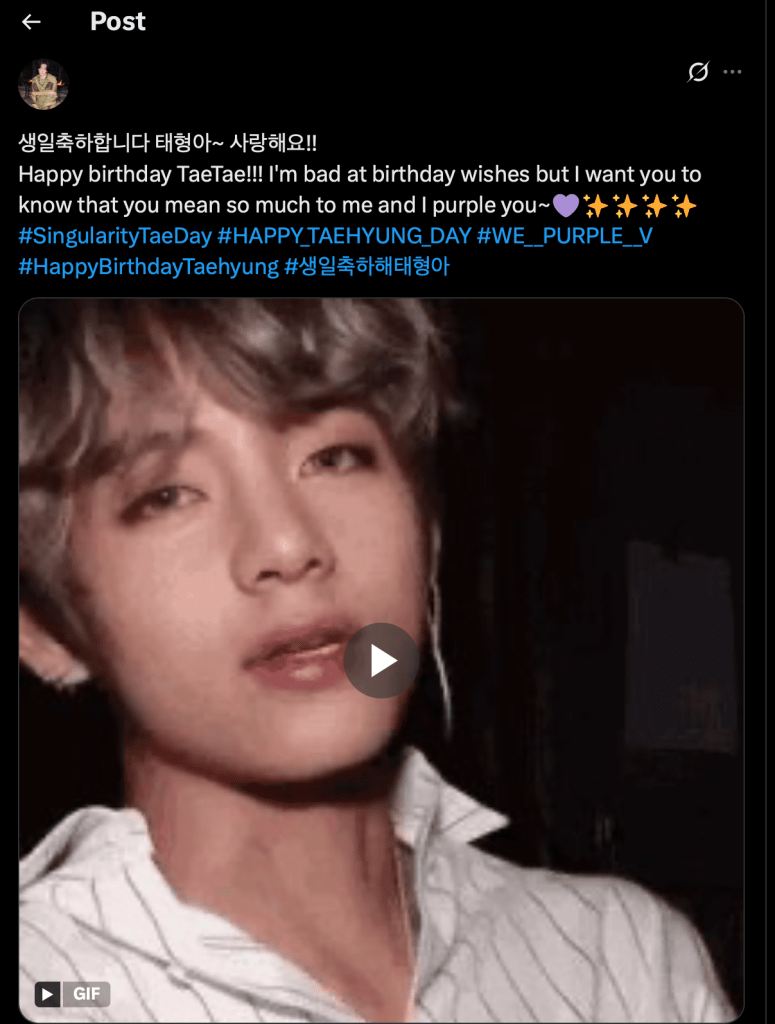
Though parasocial relationships can have their downsides, they can be a great force for organic promotion.
Misogyny and Racism Within Female-dominated Fandoms
Where fans of The Beatles faced misogyny by being dismissed as hysterical, obsessed, and overly emotional about the band that was clearly meaningful to them, BTS ARMY are faced with both this misogyny and racism.
Female fans of every demographic are constantly discredited as “preteens” lacking maturity and discernment. Fans often take incredible offense when they are dismissed and mocked for expressing their passions for their favorite artists.
Actually, K-Pop fans as a whole are criticized for supporting their favorite artists because they perform in Korean and often don’t speak English fluently. In K-Pop, language barriers are hardly considered a barrier in fandom.
K-Pop fans are very familiar with people saying, “How could you like this music so much? You can’t even understand what they are even saying.”
Women being enthusiastic about music they enjoy is often heavily frowned upon even now, but it’s undeniable that their passion isn’t a bad thing. They have the power to unite to create good results, all for the passion of the artists they love.
See this video of James Corden publicly apologizing to BTS directly in 2021 about referring to ARMY as “15-year-old girls,” a common joke at the expense of K-Pop fans.
Final Takeaways
Throughout history, dedicated female fans are a commonly misunderstood and underestimated force in the promotion and support of their favorite artists.
Their devotion and dedication can drive the popularity and promotion of clients if taken into account, and entertainment PR professional should consider them in their campaigns.
Especially considering the role of social media in client promotion, female fans need to be taken seriously, because they can be a powerful asset in entertainment PR!
BTS’s new album “Arirang” will be released next month! Consider taking a look at how fans will support their release in real time and appreciating their efforts for showing support for their favorite artists!
 Simone's Session Notes
Leave a comment